
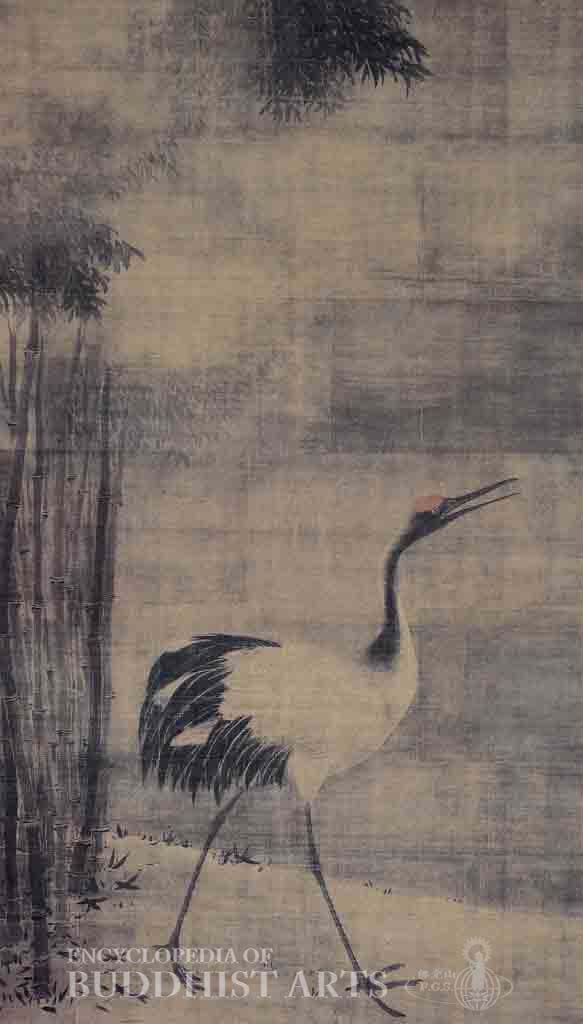
Avalokitesvara, Two Monkeys, and a Crane - Crane
Ink and color on silk
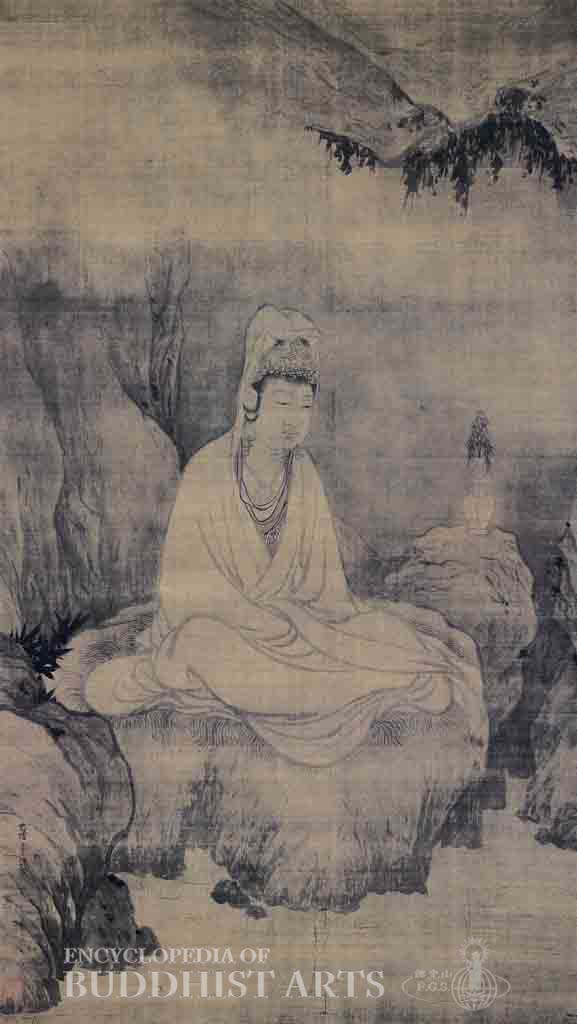
Avalokitesvara, Two Monkeys, and a Crane - Avalokitesvara
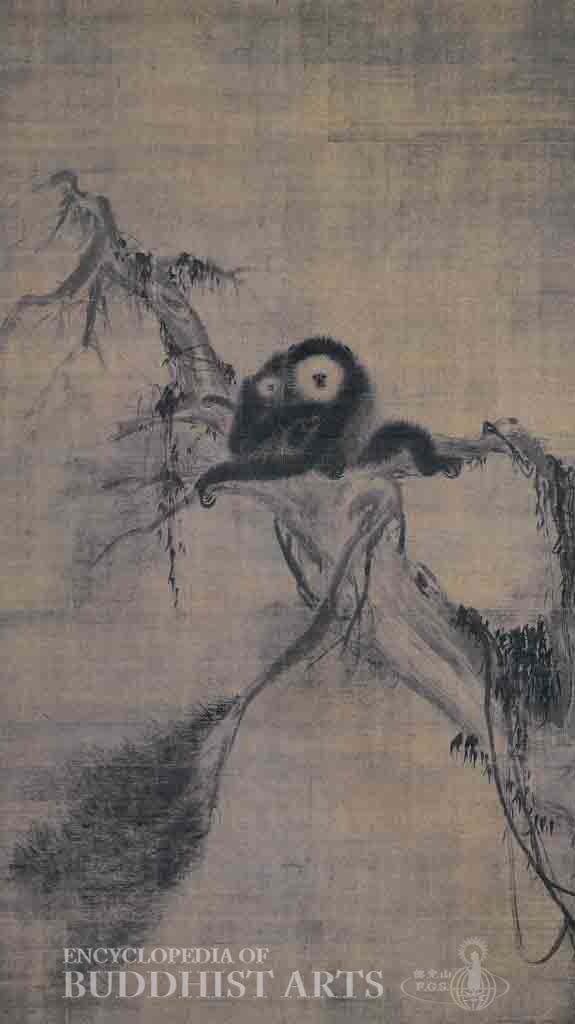
Avalokitesvara, Two Monkeys, and a Crane - Monkeys
Avalokitesvara, Two Monkeys, and a Crane
CHINA; Southern Song dynasty
This is a set of three pictures depicting Avalokitesvara Bodhisattva, a pair of monkeys, and a crane. Each of the paintings bears the collectors seal of Shogun Ashikaga Yoshimitsu. Later the paintings were given as a gift to Daitokuji Temple by Taigen Sessai, abbot of Myoshinji Temple in Kyoto. On the bottom left of the image of Avalokitesvara is the inscription “produced in reverence by Fachang, monk of Shu,” and the image is sealed “Muxi” in vermilion. Fachang was the painter’s Dharma name, Muxi his pseudonym. He lived at Changqing Temple in Zhejiang during the late Southern Song dynasty. Mu specialized in painting Buddhas and Buddhist figures, but also painted flowers, landscapes, birds, and animals. In 1951, this work was listed as a National Treasure of Japan.
Avalokitesvara, wearing earrings and a chest ornament, sits upon a grass-covered rock. A vase is painted on the right beside the Bodhisattva. Avalokitesvara wears a headdress bearing a Buddha image, draped over with a hood. The surroundings resemble a scene in the Avatamsaka Sutra: “in a rocky valley, a glittering spring winding, lush vegetation, soft fragrant grass covering the ground.” The folds of the Bodhisattva’s robe are portrayed with rounded, flowing strokes. The texture of the rock is evoked with long linen-fiber brushstrokes.
In the picture of the monkeys, mother and baby, standing in perfect stillness looking down from a great height, are perched upon a pine branch. The baby monkey is nestled in its mother’s arms. Dark ink and a dry brush are used to bring out the soft, dense texture of the fur. The branch of the pine tree bisects the painting diagonally, its cracked texture illustrated with diluted ink. Twisting vines are depicted with dark ink. The pine needles are painted using light and dark inks rubbed with a dry brush.
The third picture is of a red-crowned crane scampering out of a bamboo thicket. The background is a simple forest scene. Both the monkey and crane images are representative of Muxi’s Chan painting style. Large portions of the background are left empty, creating “implications beyond the image,” where even areas untouched by ink or brush are filled with meaning.
For more details, go to the Encyclopedia of Buddhist Arts: Painting A-H, page 83.
Cite this article:
author = Hsingyun and Youheng and Youlu and Wilson, Graham and Manho and Mankuang and Huntington, Susan,
booktitle = {Encyclopedia of Buddhist Arts: Painting A-H},
pages = 83,
title = {{Avalokitesvara, Two Monkeys, and a Crane}},
volume = 14,
year = {2016}}