

Liuhe Pagoda
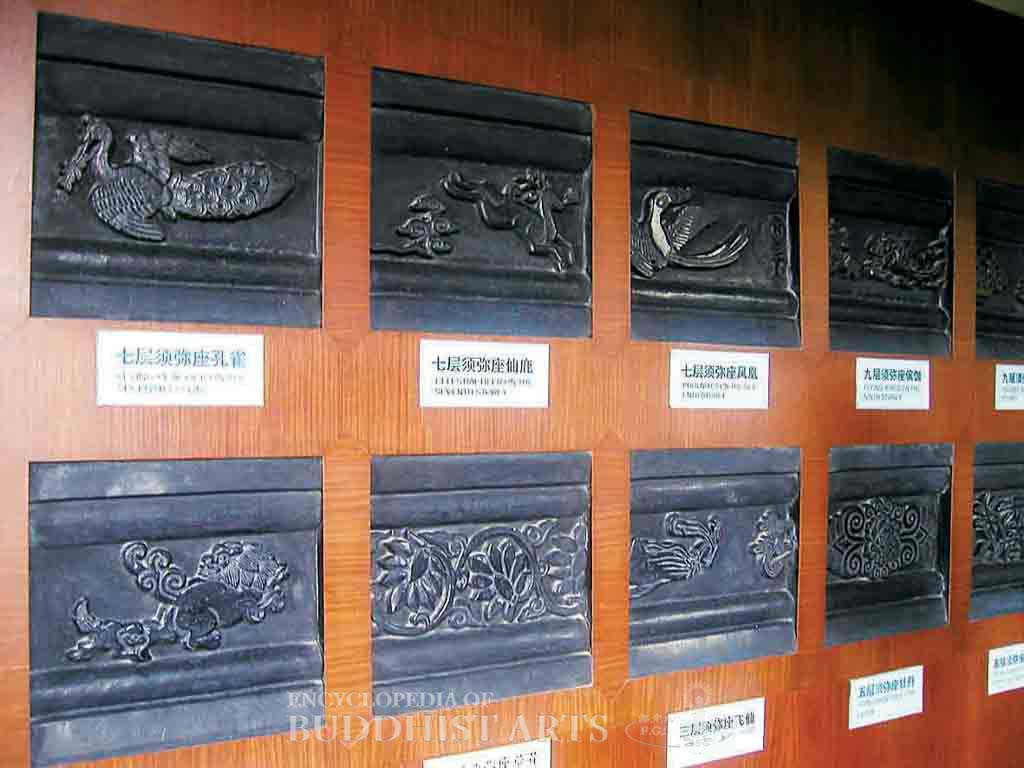
Liuhe Pagoda: Brick Reliefs
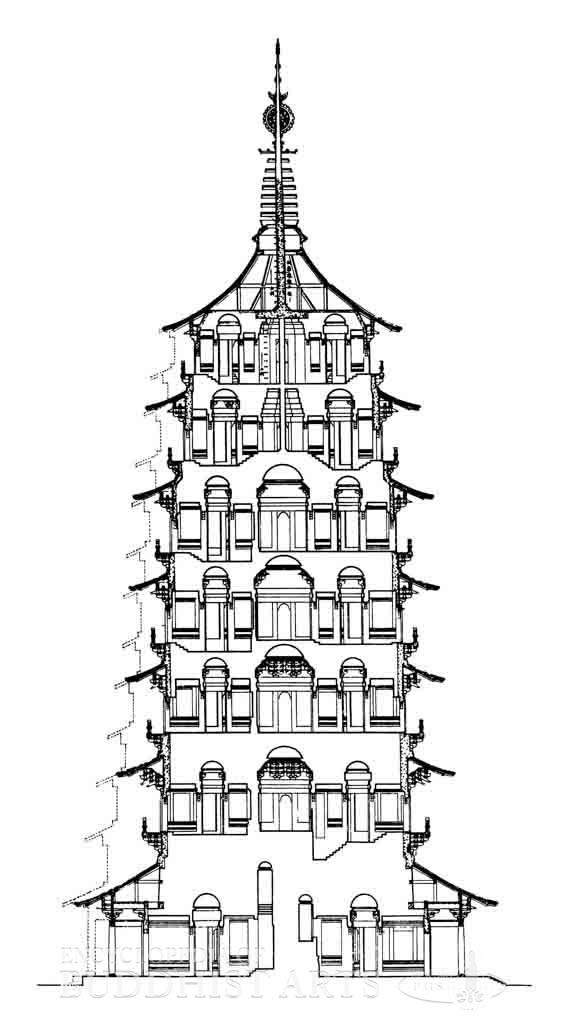
Liuhe Pagoda (section drawing)
Liuhe Pagoda
CHINA, Zhejiang, Hangzhou
Liuhe means Six Harmonies. The pagoda is located on Yuelunshan (Moon Disc Mountain), which is situated on the northern banks of Qiantang River, to the southwest of Hangzhou. It was built in 970 during the Northern Song dynasty by King Qian Hongchu (reigned 948–978) of Wuyue. The pagoda was destroyed by war in 1121 but was reconstructed in 1152 during the Southern Song dynasty by the monk Zhitan. It has undergone a number of repairs during its history. In 1934, the famous architectural scholar Liang Sicheng carried out extensive research on the pagoda and then had it restored. It was listed as a National Cultural Heritage site in 1961.
The seven-story, octagonal, brick and wood pagoda measures 60 m in height. The brick structure dates back to 1152, when it was reconstructed. When it was being repaired in 1900 during the Qing dynasty, eaves were added to form 13 eaves. There is a chamber at the center of the pagoda enclosed by an inner wall followed by a corridor and then the outer wall. Within the corridors there are spiral staircases leading to the top. The chambers are square with caisson ceilings decorated with bracket sets. Almost 200 brick reliefs have been removed from the body of the pagoda and preserved in an exhibition area. The reliefs display a wide variety of subjects, such as floral motifs, birds, animals, and heavenly dancers. The pagoda also houses precious artifacts, such as a carved Sutra in Forty-Two Sections and a Department of State Affairs stele.
For more details, go to the Encyclopedia of Buddhist Arts: Architecture G-L, page 679.
Cite this article:
author = Hsingyun and Youheng and Johnson, Peter and Mankuang and Lancaster, Lewis,
booktitle = {Encyclopedia of Buddhist Arts: Architecture G-L},
pages = 679,
title = {{Liuhe Pagoda}},
volume = 2,
year = {2016}}