
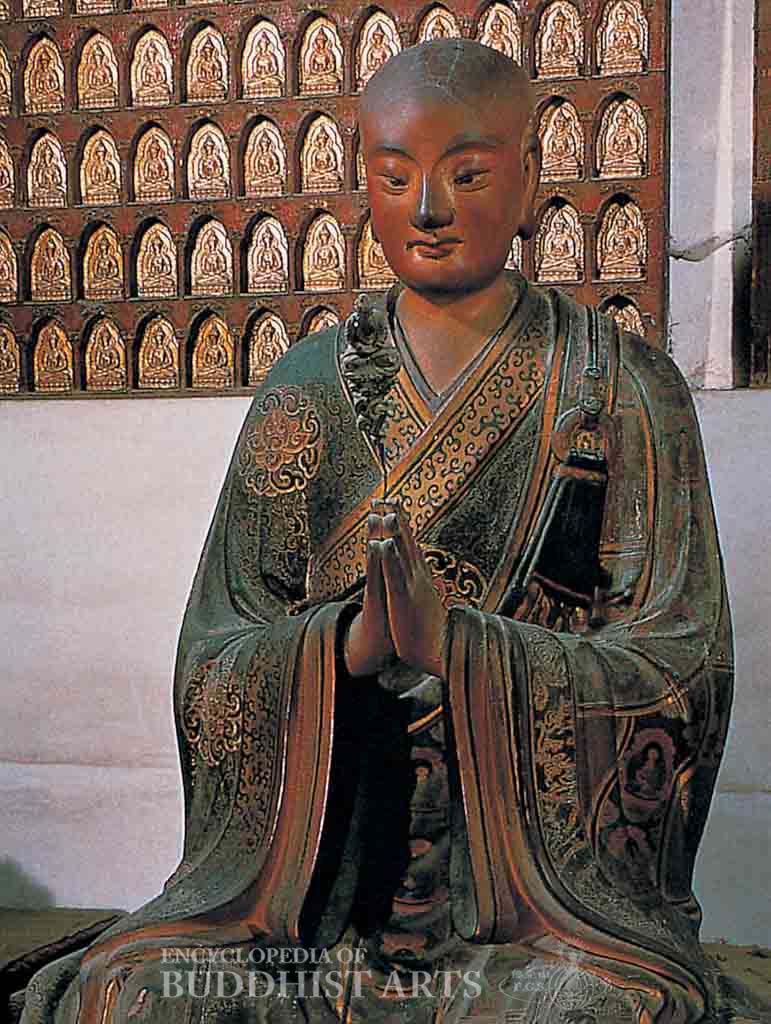
Baima Temple Great Hero Hall: Eighteen Arhats - Kanaka Bharadvaja
Dry lacquer
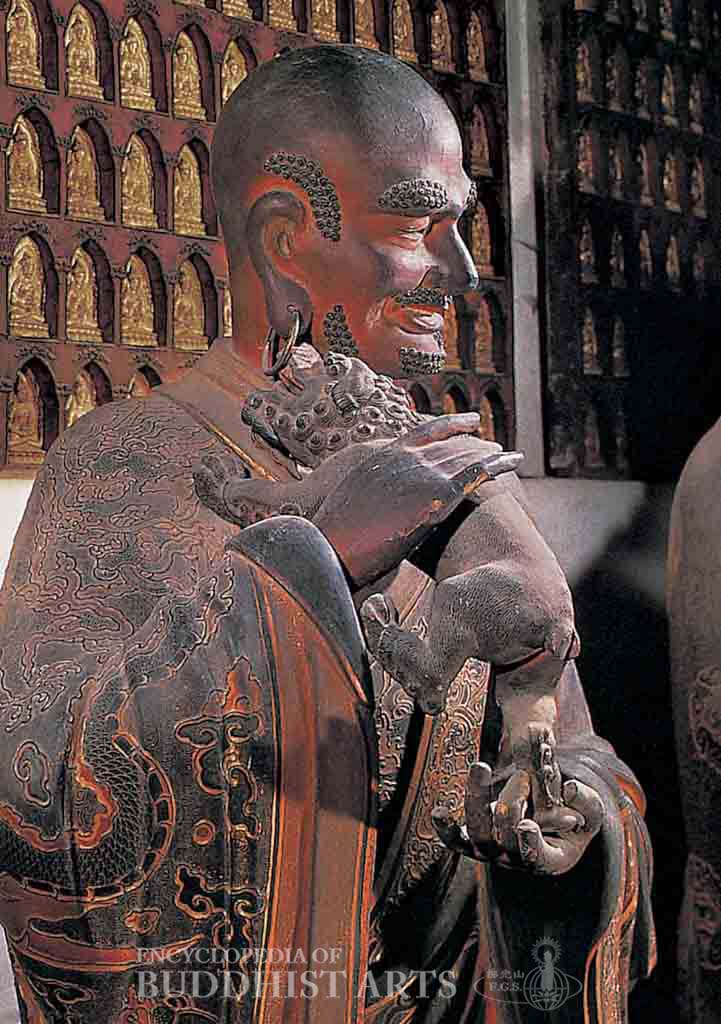
Baima Temple Great Hero Hall: Eighteen Arhats - Vajraputra
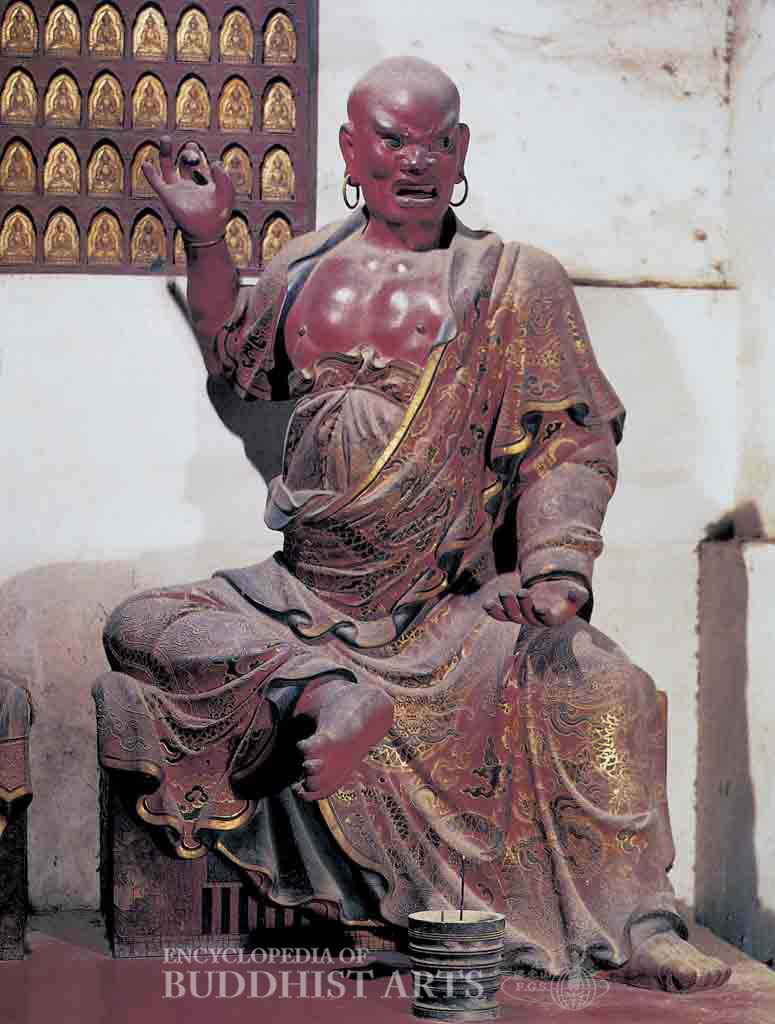
Baima Temple Great Hero Hall: Eighteen Arhats - Tiger-Taming Arhat
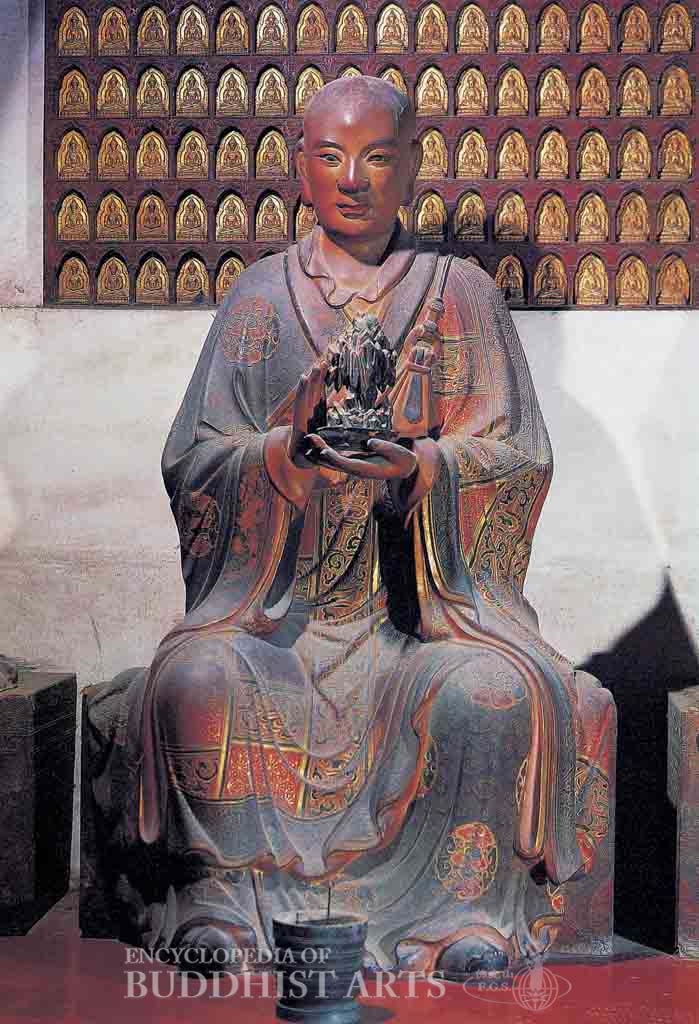
Baima Temple Great Hero Hall: Eighteen Arhats - Nandimitra
Baima Temple Great Hero Hall: Eighteen Arhats
CHINA, Henan, Luoyang; Yuan dynasty
These eighteen brightly colored Arhats are the only set of perfectly preserved lacquer statues from the Yuan dynasty (1271–1368). They originated from the Danengren Temple, but were moved to the National Palace Museum in Beijing during the Ming dynasty (1368–1644). In 1973, they were moved to Baima Temple when King Norodom Sihanouk (reigned 1941–1955, 1993–2004) of Cambodia visited the temple. They can now be found lining the sides of the Great Hero Hall with the Dragon-Subduing Arhat in the lead on the east side and the Tiger-Taming Arhat leading the west side.
The style of these statues reflects the secularization of art during the Song dynasty (960–1279). The poses of the statues differ greatly, from sitting with legs crossed or legs pendent, to ankles crossed or a relaxed posture. Some have hands joined, while others hold a variety of objects such as a whisk, alms bowl, staff, or a pen. The patterns on the monastic robes are also quite diverse. Their expressions, which truly differentiate them, range from fierce-looking and rough features to benign and delicate.
The Arhats that are pictured show Kanaka Bharadvaja with eyes focused in concentration and palms joined in reverence; a cloud with a Buddha sitting on top of it rises from his fingertips. Vajraputra is the bearded figure with the baby lion cradled in his arms, and the Tiger-Taming Arhat wears earrings and snarls fiercely as he turns to one side with one arm and one leg raised. Lastly, there is Nandimitra depicted as a young man holding a model of Mount Gandhamadana in his hands.
For more details, go to the Encyclopedia of Buddhist Arts: Sculpture A-F, page 111.
Cite this article:
author = Hsingyun and Youheng and Lovelock, Yann and Chou, Yuan and Huntington, Susan and Edson, Gary and Neather, Robert,
booktitle = {Encyclopedia of Buddhist Arts: Sculpture A-F},
pages = 111,
title = {{Baima Temple Great Hero Hall: Eighteen Arhats}},
volume = 10,
year = {2016}}