
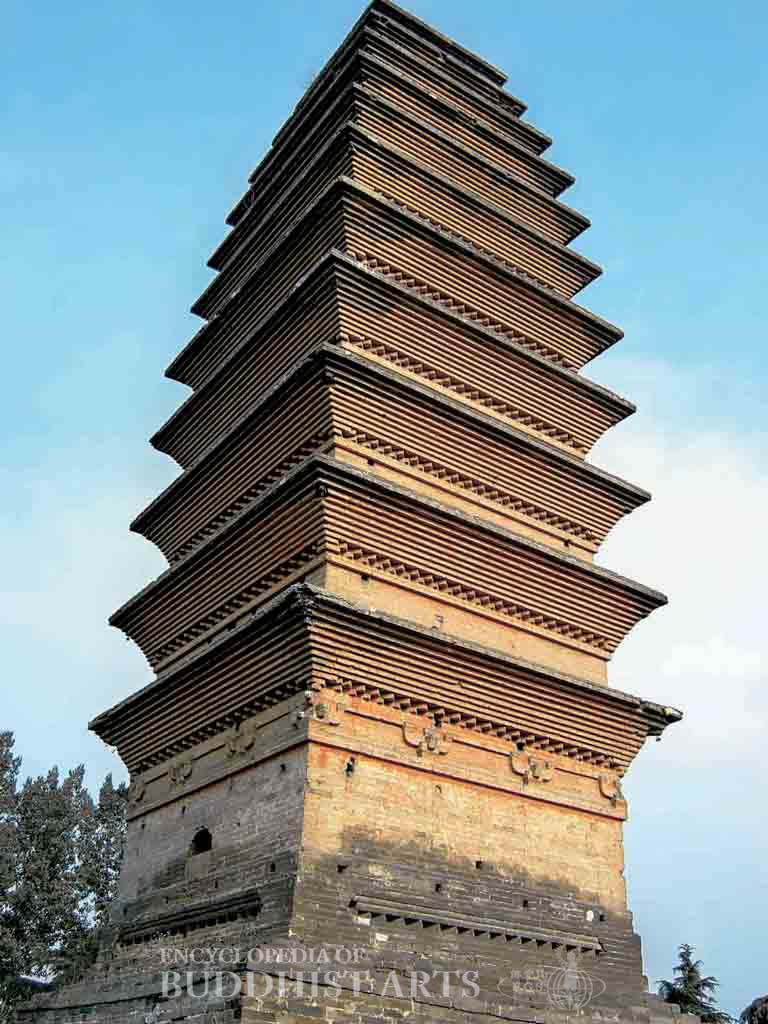
Baima Temple Qiyun Pagoda
Baima Temple Qiyun Pagoda
CHINA, Henan, Luoyang
The pagoda stands to the southeast of Baima Temple. It was originally called Sakyamuni Relic Pagoda. It is said that the original pagoda was built on the orders of Emperor Ming (reigned 57–75) of the Eastern Han dynasty. The current pagoda was rebuilt in 1175 during the Jin dynasty. It is considered to be one of the most important historical buildings of Luoyang.
The thirteen-tier, square, brick pagoda is 48 m high. It stands on a high base. There are bracket sets beneath the eaves on the first tier of the pagoda body. The eaves consist of corbeling, with a course of dogtooth bricks below. The spire is shaped like an inverted vase. The interior of the pagoda is hollow with stairs that lead to the top. Square pagodas are rather rare, since after the Five Dynasties (907–960) most pagodas were octagonal.
For more details, go to the Encyclopedia of Buddhist Arts: Architecture A-F, page 37.
Cite this article:
author = Hsingyun and Youheng and Johnson, Peter and Mankuang and Lancaster, Lewis,
booktitle = {Encyclopedia of Buddhist Arts: Architecture A-F},
pages = 37,
title = {{Baima Temple Qiyun Pagoda}},
volume = 1,
year = {2016}}