
Ruiyan: Maitreya Buddha
Granite
Ruiyan: Maitreya Buddha
CHINA, Fujian, Fuzhou; Yuan dynasty
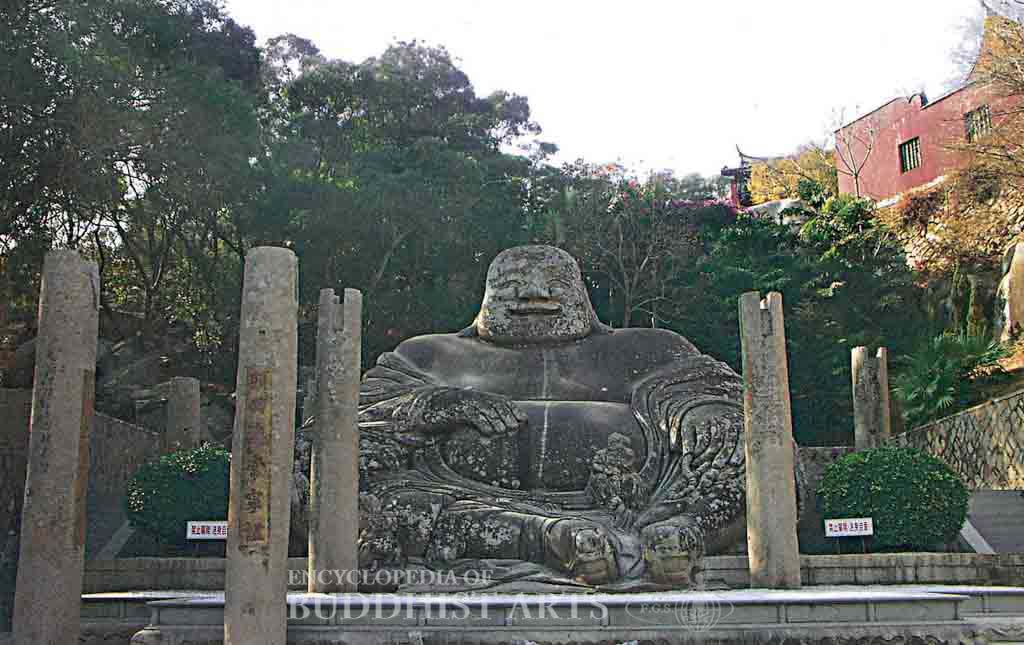
This sculpture is located at the foot of Ruiyanshan (Auspicious Cliff Mountain). It was carved into the natural rock by a group of locals, led by Lu Bogong, during the Yuan dynasty (1271–1368). Considered to be the largest stone Maitreya in China, work on it began in 1341 and was completed in 1368. A shelter was constructed over the Buddha in 1390 but only a few stone pillars remain. It was listed as a National Cultural Heritage Site in 1996.
The statue is modeled after Maitreya’s popular manifestation, Monk Budai, easily recognizable by his jolly demeanor and always smiling face. The head is broad and neckless, causing the long ears to droop over the shoulders. The right hand rests on the belly while the left holds prayer beads. The robe has slipped from the shoulders and cascades down the body between the feet, leaving most of the chest and belly exposed. Three small arhats are carved at the bottom.
For more details, go to the Encyclopedia of Buddhist Arts: Caves Mo-S, page 1336.
Cite this article:
author = Hsingyun and Youheng and Johnson, Peter and Mankuang and Huntington, Susan and Edson, Gary and Neather, Robert,
booktitle = {Encyclopedia of Buddhist Arts: Caves Mo-S},
pages = 1336,
title = {{Ruiyan: Maitreya Buddha}},
volume = 8,
year = {2016}}