
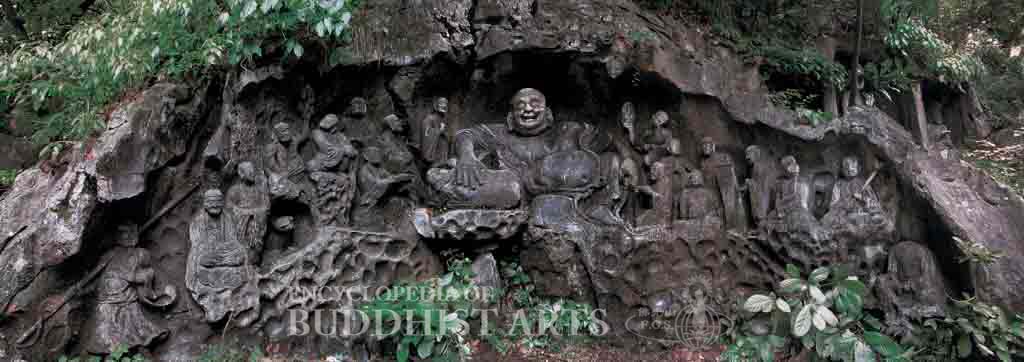
Feilai Peak Caves Niche 68: Budai and Eighteen Arhats
Feilai Peak Caves Niche 68
CHINA, Zhejiang, Hangzhou
Located on the cliff by the southern bank of Lengquan (Cold Fountain) Stream, this semicircular niche was excavated in harmony with the natural form of the rock. The niche has a width of 9 m, a height of 3.3 m at the center and 1.5 m on either end. The main figure in the niche is Budai, a manifestation of Maitreya Buddha. Budai has a broad face, a wide grin, and earlobes that extend to the shoulders. His robes are open at the front, exposing a large belly. One hand holds prayer beads, while the other rests upon a cloth sack. Carvings of the Eighteen Arhats, each with a unique appearance, flank the central figure.
According to legend, Budai was a monk who lived during the Later Liang dynasty (907–923). Cheerful and carefree, he wandered from place to place teaching the Dharma, always carrying a cloth sack. His original name was Qici, but he was often called Budai, which means “cloth sack” in Chinese. Before he passed away, Budai uttered a verse: “Maitreya, the true Maitreya, has billions of manifestations. Often he is shown to people; often they do not recognize him.” Soon after his passing, Budai himself came to be regarded as a manifestation of Maitreya. As faith in Maitreya became prevalent in China, many depictions of Budai were produced. The popularity of these images is a prominent example of the way in which Buddhist concepts were adapted and localized in China.
For more details, go to the Encyclopedia of Buddhist Arts: Caves R-L, page 366.
Cite this article:
author = Hsingyun and Youheng and Johnson, Peter and Mankuang and Huntington, Susan and Edson, Gary and Neather, Robert,
booktitle = {Encyclopedia of Buddhist Arts: Caves R-L},
pages = 366,
title = {{Feilai Peak Caves Niche 68}},
volume = 6,
year = {2016}}