
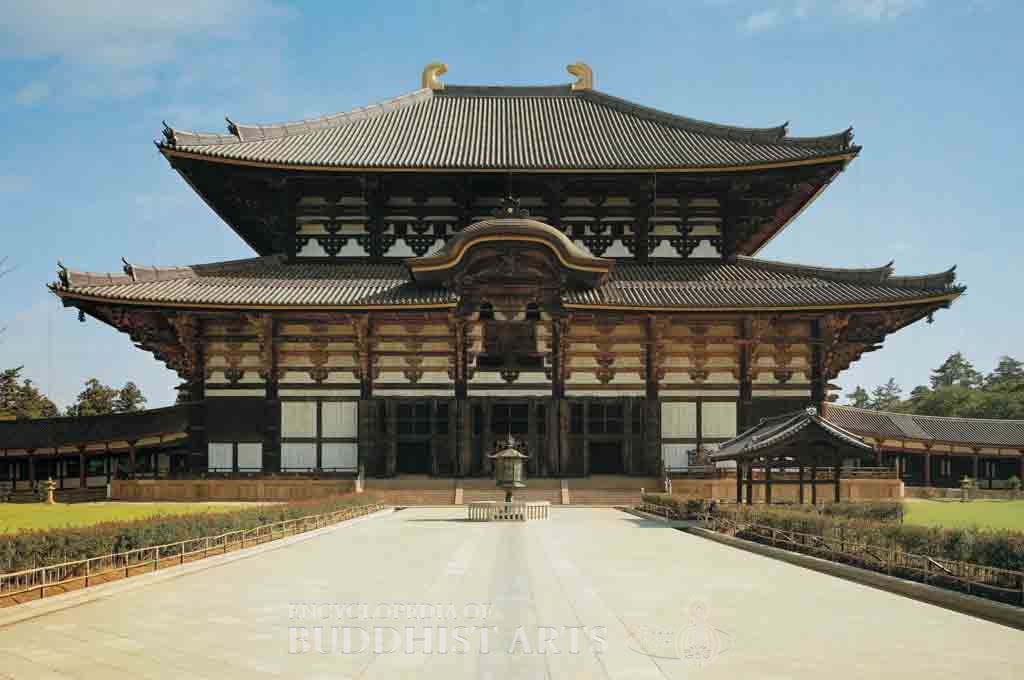
Todaiji Temple: Golden Hall
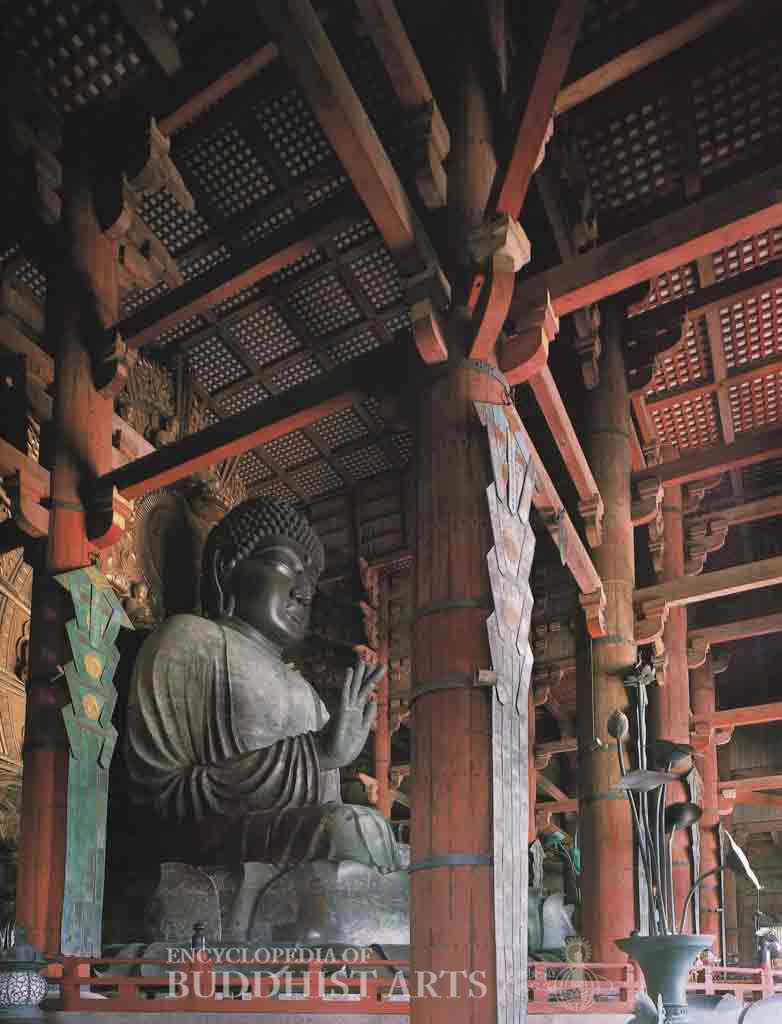
Todaiji Temple: Golden Hall (interior)
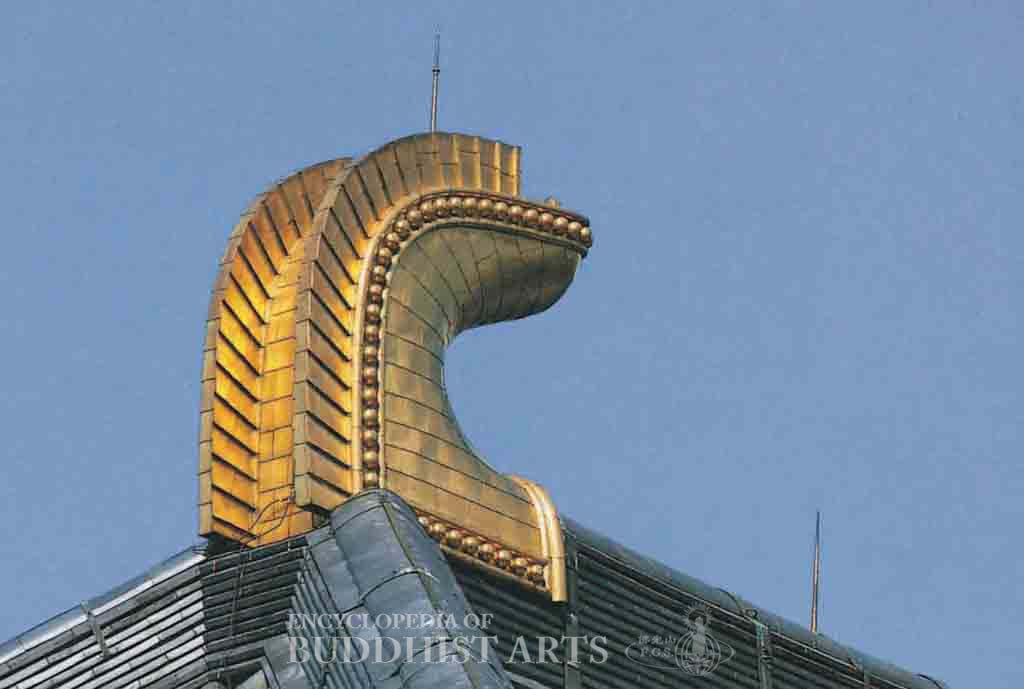
Todaiji Temple: Golden Hall - Ridge Ornament
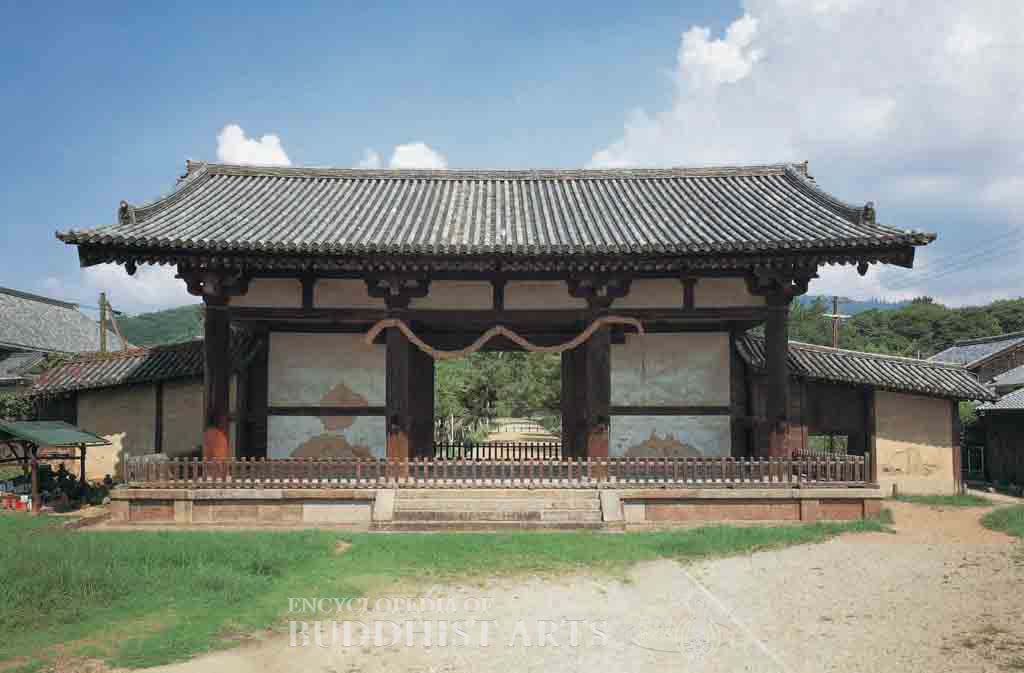
Todaiji Temple: North Gate
Todaiji Temple
JAPAN, Nara
Todaiji, or Great Eastern Temple, is the head temple of the Kegon school of Japanese Buddhism. The temple was founded in 728 during the Nara period and was originally named Kinshosenji (Golden Bell Temple). In 741 Emperor Shomu (reigned 724–749) issued an imperial order for the construction of provincial temples around the country as a prayer for national protection. Kinshosenji was then promoted and renamed Kinkomyoji (Golden Light Temple). As the temple was built on the east side of the capital, Heijo (present day Nara), its name was then changed to Todaiji. In the same year, an imperial order was given for the construction of a giant bronze statue of the seated Vairocana Buddha, known in Japanese as Daibutsu (Great Buddha).
In 753 Chinese Master Jianzhen arrived in Japan and traveled to Nara to impart the precepts. Initially ordinations were held in the Golden Hall; however, in the following year an ordination hall was built on the west side of the Golden Hall. It was one of the first ordination halls in Japan. During the Kamakura (1185–1333) and Edo (1615–1868) periods, the temple attained a highly influential status in Japanese society. It is the head temple of the 68 provincial temples. As part of the Historic Monuments of Ancient Nara, it was listed as a UNESCO World Heritage Site in 1998.
The buildings are spread out in the extensive temple grounds. They include the Golden Hall, Lotus Hall, Second Month Hall, founder’s hall, north gate, south gate, Shosoin (Treasure House), bell tower, sutra repository, and the chanting hall. A number of the buildings have been listed as National Treasures.
The Golden Hall, commonly known as the Great Buddha Hall, was rebuilt in 1195 during the Kamakura period and again in 1709 during the Edo period. It was constructed in a combination of the wayo and daibutsuyo styles. The building was initially eleven bays wide but later became seven bays wide with a veranda surrounding it. It is 57 m wide, 50.5 m deep, and 47.5 m high. It has a double-eave hip roof covered in cylindrical tiles. At the front, on the lower roof, there is an auxiliary roof with a curved bargeboard. There are golden ridge ornaments at either side of the main ridge in Tang dynasty style. The hall has been strengthened with huge columns, measuring 15 m in diameter, and there are eight additional columns with six-tier bracket sets to support the heavy roof. Within the hall there is a 14.85 m high seated statue of Vairocana Buddha, which is the largest indoor gilt bronze Buddha statue in Japan.
The Lotus Hall is the only extant hall built during the Nara period (710–794). A seated statue of Master Roben is enshrined within the three-by-three bay founder’s hall, which has a single-eave pyramidal roof. The south gate is the largest temple gate in Japan. The three-bay wide north gate has an overhanging gable roof and is built in the typical eight-pillar gate style, modeled after temple gates built between the Nara and Heian periods. The gate houses statues of deities and also contains a stage.
Following the founding of the temple, precious artifacts from China were collected, resulting in the considerable cultural achievements of the Nara period. The buildings house a rich variety of Buddhist works of art, many of which are National Treasures.
For more details, go to the Encyclopedia of Buddhist Arts: Architecture T-Z, page 1133.
Cite this article:
author = Hsingyun and Youheng and Johnson, Peter and Mankuang and Lancaster, Lewis,
booktitle = {Encyclopedia of Buddhist Arts: Architecture T-Z},
pages = 1133,
title = {{Todaiji Temple}},
volume = 4,
year = {2016}}