
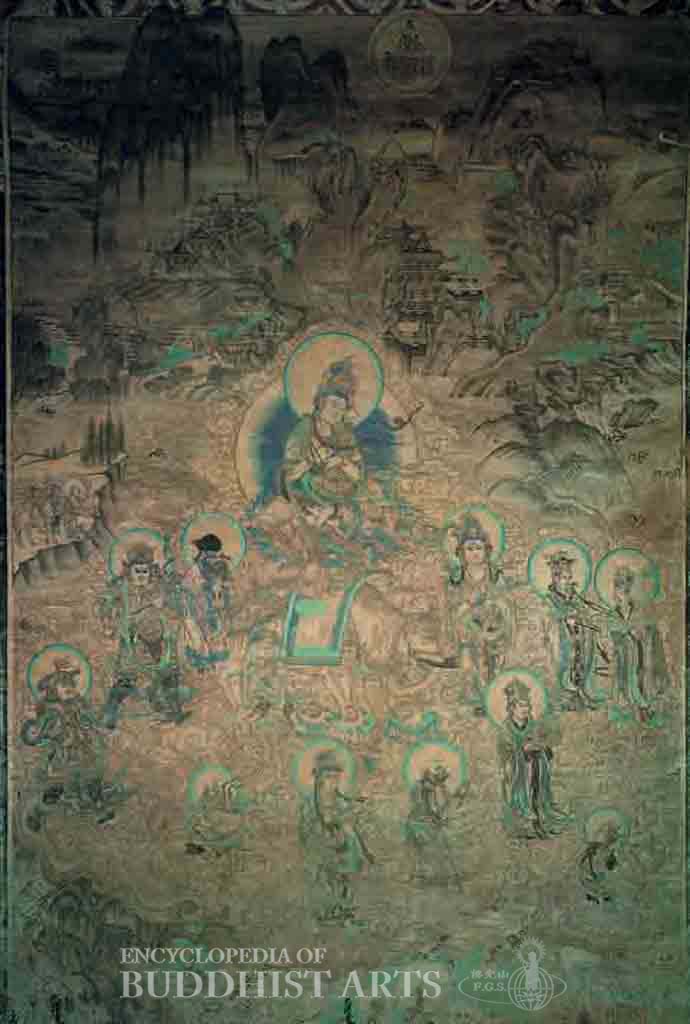
Yulin Cave 3: Samantabhadra Bodhisattva and Attendants
Yulin Cave 3: Samantabhadra Bodhisattva and Attendants
CHINA, Gansu, Guazhou; Western Xia period
This mural is located on the left side of the front (west) wall, and is paired with the illustration of Manjusri Bodhisattva and Attendants on the right side. Samantabhadra Bodhisattva is seated upon a lotus throne and rides a six-tusked white elephant as lotus flowers bloom beneath its feet. Samantabhadra is escorted by an entourage that includes Bodhisattvas, Arhats, and Heavenly Kings. An image of Master Xuanzang’s Journey to Obtain the Sutras appears to the left of Samantabhadra. The scenery gives an impression of seclusion and beauty. Layers of soaring peaks ascend into the landscape beyond the retinue. Among the peaks are towers and thatched cottages enclosed within bamboo fences.
The artist of this mural employed different types of lines in order to create differing effects among the figures and shapes. The mountains are drawn with thick, hazy lines that portray the sheer and imposing manner of the peaks. Clouds and mist are depicted with tight swirls, packed together layer upon layer. Finally, the figures are created using the “iron wire” painting technique. Formed with neat, delicate lines, they are well-proportioned and gracefully portrayed. The painting is washed in a thin layer of paint so as not to hide the ink effect. The style is closely related to the traditional painting style of the Northern Song dynasty (960–1127).
Illustrations created during the early Western Xia period (1032–1227) typically adopted the artistic styles of the Song dynasty (960–1279), but it was not until the late Western Xia that the influence of the landscape painting of the Northern Song became prominent. Though it remains in the background, the landscape occupies a substantial portion of this mural. It has been particularly valuable for research into the evolution of both landscape painting and sutra illustration.
For more details, go to the Encyclopedia of Buddhist Arts: Caves T-Z, page 1574.
Cite this article:
author = Hsingyun and Youheng and Johnson, Peter and Mankuang and Huntington, Susan and Edson, Gary and Neather, Robert,
booktitle = {Encyclopedia of Buddhist Arts: Caves T-Z},
pages = 1574,
title = {{Yulin Cave 3: Samantabhadra Bodhisattva and Attendants}},
volume = 9,
year = {2016}}