
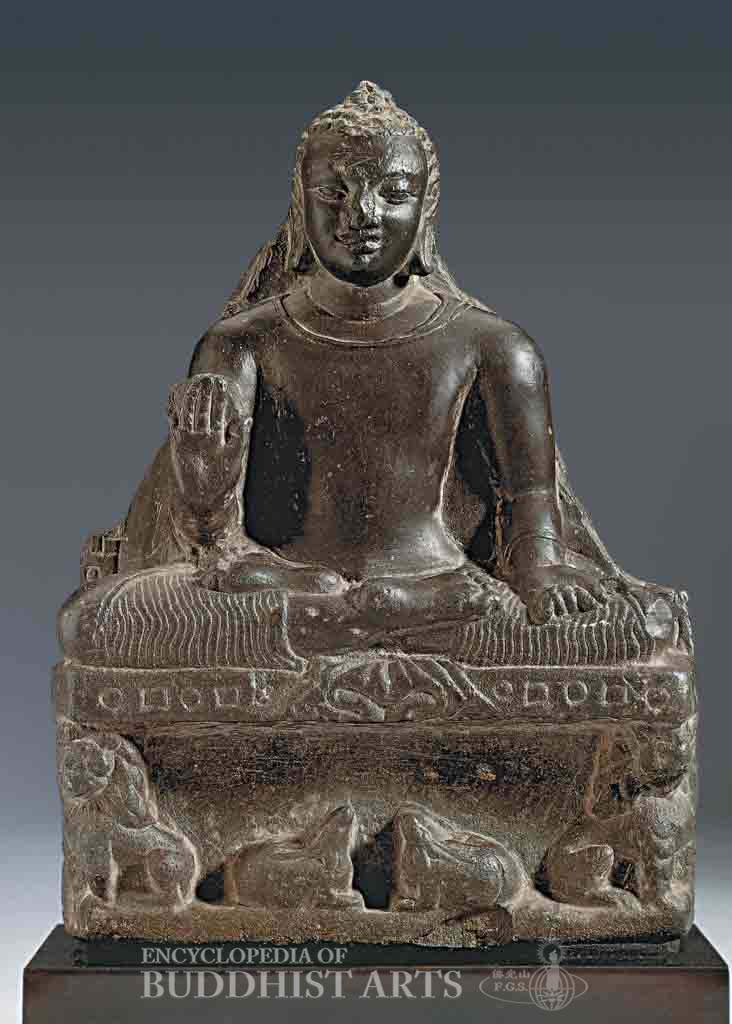
Seated Buddha
Stone
Seated Buddha
NEPAL; Licchavi Kingdom
The sculpture shows characteristics found in statues from the Licchavi Kingdom (circa 300–879) that was mostly influenced by the Indian Gupta (circa 320–550) style. The figure sits in full lotus position with the right hand raised in abhaya (fearlessness) mudra. The monastic robe that covers both shoulders is smooth but the wave-like folds on the skirt are prominently represented. The edge of the throne is decorated with alternating squares and circles. A pair of lions supports the corners of the throne with two crouching deer between them. The deer have their heads raised, a configuration that normally signifies the Buddha’s first teaching. The broken throne back may have formed an aureole and nimbus.
For more details, go to the Encyclopedia of Buddhist Arts: Sculpture N-Sr, page 1026.
Cite this article:
author = Hsingyun and Youheng and Lovelock, Yann and Chou, Yuan and Huntington, Susan and Edson, Gary and Neather, Robert,
booktitle = {Encyclopedia of Buddhist Arts: Sculpture N-Sr},
pages = 1026,
title = {{Seated Buddha}},
volume = 12,
year = {2016}}