
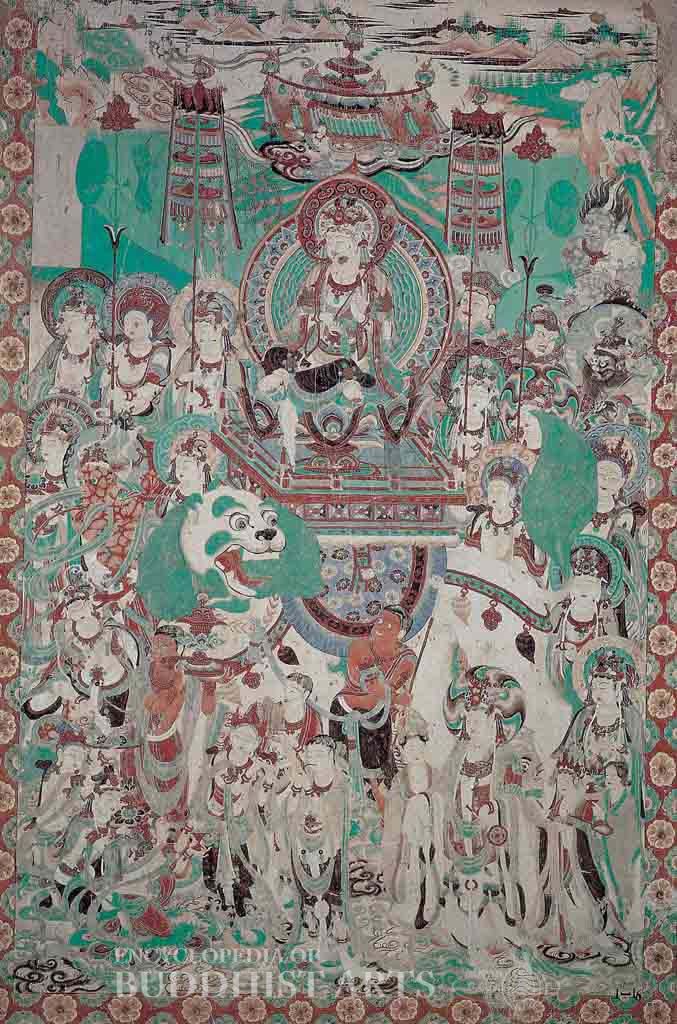
Mogao Cave 159: Manjusri Bodhisattva and Attendants
Mogao Cave 159: Manjusri Bodhisattva and Attendants
CHINA, Gansu, Dunhuang; Tang dynasty
This mural is painted on the right beside the back (west) wall niche within the main chamber. Manjusri is in the center, riding a large white lion. Sakra follows alongside Manjusri, and a retinue of heavenly musicians, Bodhisattvas, and the Eight Classes of Dharma Protectors surround the Bodhisattva. Manjusri is clad in a celestial garment and wears a crown and other ornaments. The Bodhisattva holds a ruyi (wish-fulfilling talisman) and sits serenely on a lotus seat which is placed on a square pedestal upon the lion’s back. Manjusri’s nimbus is decorated with lotus petals and cloud patterns, and the colorful aureole is adorned with ribbons and triangles. The lion has a green mane and tail. It glares ferociously with eyes wide and mouth agape. The animal is flanked by attendants, one grasping a rope that is tied to the lion, and the other holding an incense burner in both hands. The attendants are clad in short dhotis and wear necklaces, bracelets, and long stoles. The attendant holding the rope stares at the lion, who looks back to meet his gaze. Above the retinue is a landscape of lakes and mountains surrounded by clouds. The mural is framed by circular and semicircular floral patterns.
A corresponding illustration of Samantabhadra and Attendants is painted on the left beside the back wall niche. This complimentary arrangement of images of Manjusri and Samantabhadra first appeared during the Early Tang period (618–712), and by the Mid-Tang period (756–846), such images were numerous and their composition was increasingly delicate.
For more details, go to the Encyclopedia of Buddhist Arts: Caves M-Mo, page 993.
Cite this article:
author = Hsingyun and Youheng and Johnson, Peter and Mankuang and Huntington, Susan and Edson, Gary and Neather, Robert,
booktitle = {Encyclopedia of Buddhist Arts: Caves M-Mo},
pages = 993,
title = {{Mogao Cave 159: Manjusri Bodhisattva and Attendants}},
volume = 7,
year = {2016}}